
Cindy Richard | LXD
Matrix
AECT 2012 Standards Matrix Table
| Standards | Performance Indicators | Project 1 EDTC 6320 | Project 2 EDTC 6321 | Project 3 EDTC 6323 | Project 4 EDTC 6325 | Project 5 EDTC 6332 | E-Portfolio |
| Content Knowledge | 1.1 | x | x | x | x | x | |
| 1.2 | x | x | x | x | x | x | |
| 1.3 | x | x | x | ||||
| 1.4 | x | x | x | ||||
| 1.5 | x | x | x | x | |||
| Content Pedagogy | 2.1 | x | x | x | x | x | |
| 2.2 | x | x | x | x | x | ||
| 2.3 | x | x | x | ||||
| 2.4 | x | x | x | x | x | ||
| 2.5 | x | x | x | x | x | x | |
| Learning Environments | 3.1 | x | x | x | x | x | x |
| 3.2 | x | x | x | x | x | ||
| 3.3 | x | x | x | ||||
| 3.4 | x | x | x | ||||
| 3.5 | x | x | x | x | x | ||
| 3.6 | x | x | x | x | |||
| Professional Knowledge and Skills | 4.1 | x | x | x | x | ||
| 4.2 | x | x | |||||
| 4.3 | x | x | x | ||||
| 4.4 | x | x | x | x | |||
| 4.5 | x | x | x | x | x | ||
| Research | 5.1 | x | x | x | |||
| 5.2 | x | x | |||||
| 5.3 | x | x | x | ||||
| 5.4 | x | x |
Project Summary Tables

EDTC 6320 -- Cooperative Project
Project Description:
You Need an Educational Technologist! was a collaborative team project designed to introduce organizational leaders to the strategic value of educational technologists in closing workplace performance gaps. The project included a formal client proposal analyzing the target audience of business executives, identification of the instructional problem, and articulation of measurable learning objectives. Grounded in Mayer’s Cognitive Theory of Multimedia Learning and research on working memory and cognitive load, the team developed detailed storyboards, scripted a 3–5 minute executive-focused video, and produced an accessible multimedia presentation aligned with AECT professional standards. Together, the client proposal, research-based design rationale, storyboard planning, and final video demonstrate a systematic approach to instructional design that emphasizes clarity, inclusivity, ethical practice, and measurable organizational impact.
Project Link | Artifact Report
AECT Standards Met: This project meets the following standards:
Standard 1: Content Knowledge
1.2, 1.5
Standard 2: Content Pedagogy
2.5
Standard 3: Learning Environments
3.1, 3.5
Standard 4: Professional Knowledge and Skills
4.1, 4.5
Standard 5: Research
5.1
EDTC 6321 -- Instructional Design Project
Project Description:
This instructional design project documents the systematic development of a complete instructional unit using the ADDIE framework. Across Instructional Units (IU) 1–4, the project includes a front-end analysis of learner characteristics and instructional needs, measurable performance objectives, aligned assessment instruments, instructional strategies grounded in learning theory, and a structured implementation and evaluation plan. The design process demonstrates a full instructional systems approach—from needs assessment through formative and summative evaluation planning—emphasizing alignment between goals, activities, and assessments to improve measurable learning outcomes.
Project Link | Artifact Report
AECT Standards Met: This project meets the following standards:
Standard 1: Content Knowledge
1.1, 1.2
Standard 2: Content Pedagogy
2.1, 2.2, 2.4, 2.5
Standard 3: Learning Environments
3.1, 3.2, 3.6
Standard 4: Professional Knowledge and Skills
4.4, 4.5
Standard 5: Research
5.1, 5.2, 5.3
EDTC 6323 -- Interactive Multimedia Object
Project Description:
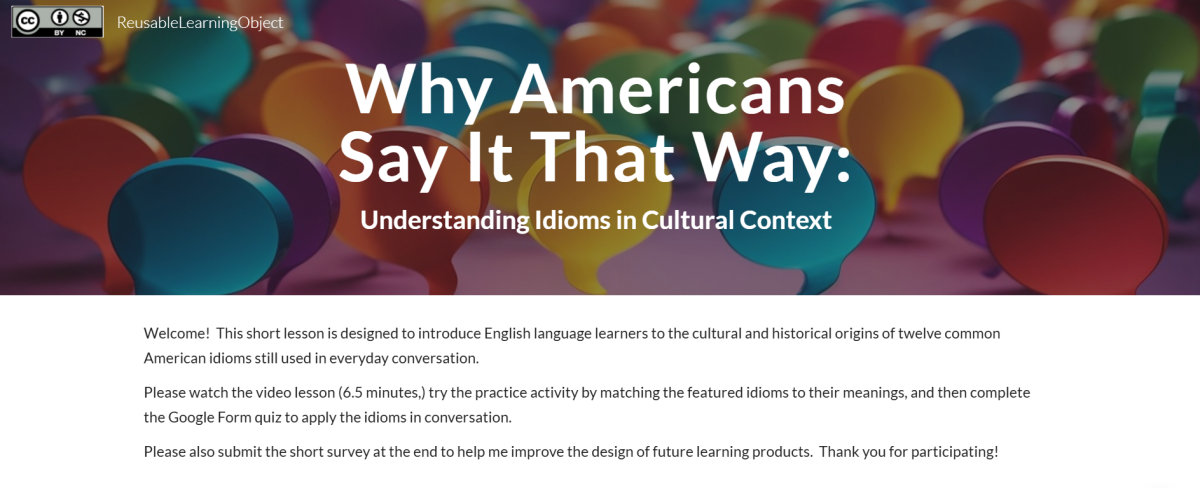
Why Americans Say It That Way: Understanding Idioms in Cultural Context is a multimedia Reusable Learning Object (RLO) designed for B2-level English language learners. The lesson introduces twelve common American idioms organized into four thematic clusters—Frontier & Exploration, Conflict & Resolution, Sports & Teamwork, and Expression & Emotion—through narrated visuals, captions, and contextual examples. Learners reinforce understanding through a drag-and-drop matching activity and a Google Form quiz requiring contextual application in conversational dialogue. The project includes a formal summative evaluation using Kirkpatrick Levels 1 and 2 to measure learner reaction and performance outcomes, with pilot data collected from Ukrainian university students. Findings informed targeted revisions to improve clarity, reduce cognitive load, and enhance mobile usability, demonstrating a complete instructional design cycle from analysis through evaluation.
Project Link | Artifact Report
AECT Standards Met: This project meets the following standards:
Standard 1: Content Knowledge
1.1, 1.2
Standard 2: Content Pedagogy
2.1, 2.2, 2.4, 2.5
Standard 3: Learning Environments
3.1, 3.2, 3.5, 3.6
EDTC 6325 -- E-Learning Design Project
Project Description:
This fully online, self-paced media literacy course, called Get Media Savvy: The Real Scoop About Fake News, was designed for high school students (and adaptable for adult learners) to strengthen critical evaluation skills across text, images, and video. The four-lesson Canvas module addresses how disinformation spreads, how emotional and psychological manipulation tactics operate, how algorithms amplify misinformation, how to evaluate media bias, how to fact-check using reliable tools, and how to detect manipulated or AI-generated images. Learners complete multimedia lessons, interactive activities, discussion prompts, and quizzes aligned to measurable objectives, with performance benchmarks set at 80% accuracy or higher. The course integrates verification tools such as media bias charts, Snopes, FactCheck.org, Google Reverse Image Search, and TinEye, emphasizing applied digital literacy skills transferable beyond the classroom.
Project Link | Artifact Report
AECT Standards Met: This project meets the following standards:
Standard 1: Content Knowledge
1.1, 1.2, 1.3, 1.4, 1.5
Standard 2: Content Pedagogy
2.1, 2.2, 2.3, 2.4, 2.5
Standard 3: Learning Environments
3.1, 3.2, 3.3, 3.4, 3.5, 3.6
Standard 4: Professional Knowledge and Skills
4.1, 4.3, 4.4, 4.5
EDTC 6332 -- Practicum Project
Project Description:
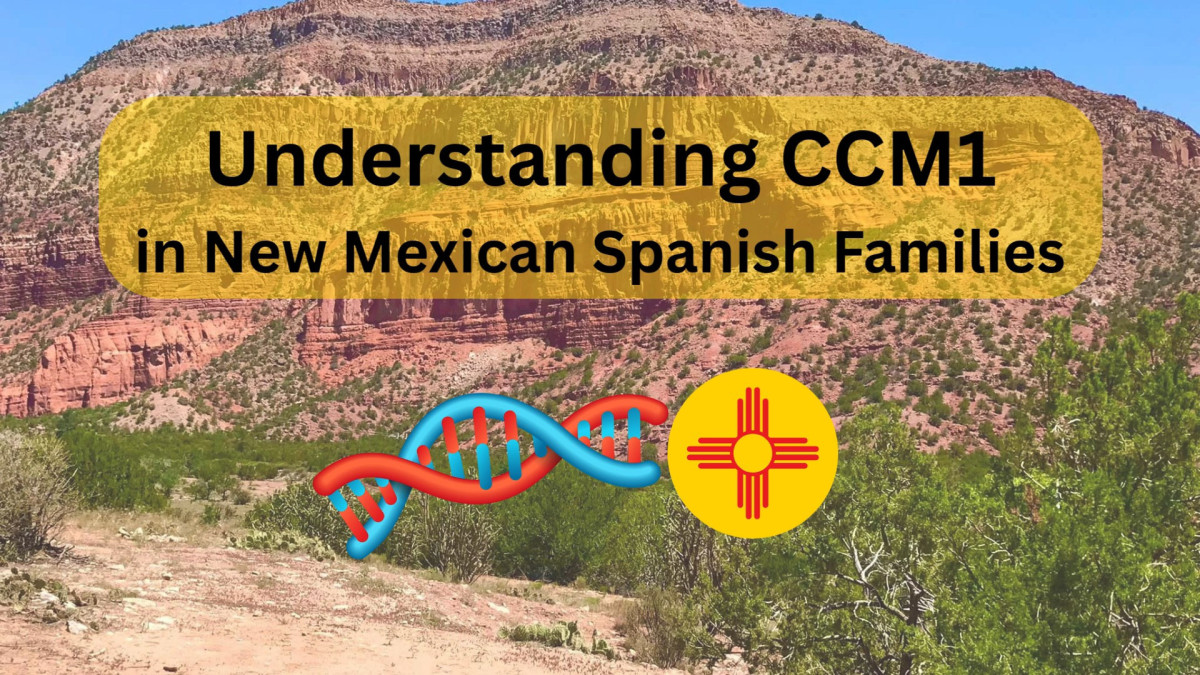
CCM1: A Genetic Risk Linked to New Mexican Spanish Ancestry is a web-based, interactive microlesson designed to increase awareness of Cerebral Cavernous Malformation Type 1 (CCM1) among adults of New Mexican Spanish descent. The module explains what CCM1 is, why it is more prevalent in this population due to a founder effect, and what optional next steps—such as discussing symptoms or family history with a healthcare provider—may be considered. Through brief video segments, interactive checkpoints, and a curated resource list, the lesson promotes informed, culturally respectful health awareness without encouraging alarm or medical decision-making.
Project Link | Artifact Report
AECT Standards Met: This project meets the following standards:
Standard 1: Content Knowledge
1.1, 1.2, 1.3, 1.4, 1.5
Standard 2: Content Pedagogy
2.1, 2.2, 2.3, 2.4, 2.5
Standard 3: Learning Environments
3.1, 3.2, 3.3, 3.4, 3.5
Standard 4: Professional Knowledge and Skills
4.1, 4.2, 4.3, 4.4, 4.5
Standard 5: Research
5.3, 5.4

Last updated on February 22, 2026.